Classical, Jazz, or Ambient: What Your Cat's Musical Taste Actually Tells You
You've probably noticed it before. You flip on a playlist, and your cat either melts into the couch cushions or suddenly finds somewhere else to be. It doesn't feel random — and honestly, it isn't. The genre you choose matters more than most cat owners realize, and the reasons why are rooted in some genuinely fascinating biology.
At Cat Calm Radio, we spend a lot of time thinking about sound and what it does to the animals sharing our homes. So let's get into it: why do cats respond so differently to classical, jazz, and ambient music — and what does your cat's reaction actually tell you about them?
First, a Quick Note on How Cats Process Sound
Before we dive into genres, it helps to understand what makes a cat's auditory experience so different from ours. Cats hear a much wider frequency range than humans — they can detect sounds up to around 79,000 Hz, compared to our ceiling of roughly 20,000 Hz. They're also exquisitely sensitive to rhythm, repetition, and tonal variation, since those cues in the wild would signal the difference between prey, predator, and nothing worth bothering about.
What this means for music is that tempo, pitch consistency, and the presence of sharp transient sounds (sudden loud notes, percussive hits, dissonant chords) all land differently on a cat's nervous system than they do on ours. A song that feels mellow to you might still carry frequencies or rhythmic jolts that keep your cat subtly on edge.
Classical Music: The Genre with the Most Research Behind It
Classical music has been studied more than any other genre in relation to cat behavior, partly because researchers at institutions like Louisiana State University have specifically tested it in clinical settings — including veterinary offices, where stress levels are easy to measure.
The broad finding? Cats exposed to classical music during stressful situations showed measurably lower stress indicators than cats in silence or cats exposed to pop music. But not all classical is created equal.
Slow, melodic composers tend to win. Think Debussy's Clair de Lune, Satie's Gymnopédies, or Brahms' lullabies. These pieces share a few key traits: gradual tempo, minimal percussive impact, smooth harmonic progressions, and a general lack of dramatic dynamic swings. For cats, that translates to a sonic environment with no sudden "threats" — nothing that triggers the startle reflex or demands attention.
Contrast that with something like Beethoven's Fifth Symphony or Stravinsky's Rite of Spring. Both are brilliant, but the abrupt dynamic shifts and complex rhythmic patterns can actually elevate a cat's alertness rather than reduce it. Some cats find that stimulating in a good way. Others just leave the room.
Best use case for classical: Winding down in the evening, post-play relaxation, or creating a calm backdrop during thunderstorms or fireworks.
Jazz: It Depends Entirely on the Subgenre
Jazz is tricky because it's such a broad category. Smooth jazz and bebop are basically different planets.
Cats tend to do well with slower, more melodic jazz — think Miles Davis's Kind of Blue era, or the quieter end of Chet Baker's catalog. The consistent tempo, the warm tonal palette of muted trumpets and brushed drums, and the relatively low dynamic range create something that functions almost like classical in its effect on feline nervous systems.
Fast bebop, free jazz, or anything with aggressive improvisation is a different story. The unpredictability — which is literally the point of free jazz — runs counter to what most cats find settling. Cats are creatures of pattern recognition. Music that constantly subverts expectations doesn't give them anything to relax into.
There's also the matter of certain instruments. Cats often respond more positively to strings and woodwinds than to brass played at full volume. A saxophone breathy and low is one thing; a trumpet blasting at full velocity is another.
Best use case for jazz: Daytime background sound when you want something a little more textured than pure ambient, or for cats who seem indifferent to classical but need something gentle.
Ambient Music: Purpose-Built for the Feline Nervous System
This is where things get really interesting — and where Cat Calm Radio lives.
Ambient music, especially the kind designed with animals in mind, tends to check almost every box that matters for a cat's auditory comfort. Slow tempos (often 50–70 BPM, which mirrors a resting heart rate). Minimal percussive transients. Layered textures that evolve gradually rather than jumping. Frequencies that stay within comfortable ranges. And often, natural sound elements — flowing water, rustling leaves, soft rain — that carry an inherent "safety signal" for cats.
Researcher Charles Snowdon at the University of Wisconsin pioneered the idea of "species-appropriate music" — compositions built around the tempo and frequency range that's actually meaningful to cats rather than humans. His work with musician David Teie produced tracks that incorporated cat-specific vocalizations and purr-like rhythms, and the results were striking: cats approached the speakers, rubbed against them, and showed clear behavioral signs of comfort.
Modern ambient artists like Moby (in his more stripped-back work), Brian Eno's Ambient 1: Music for Airports, and purpose-built cat music composers all create in a space that tends to resonate well with feline listeners. The genre's defining quality — its willingness to be still — is exactly what makes it so effective.
Best use case for ambient: Separation anxiety when you're away from home, overnight calming, post-vet recovery, or any situation where you need your cat's nervous system to genuinely downshift.
Reading Your Cat's Genre Reaction
Here's the honest truth: individual cats vary more than any genre study can fully capture. A cat who grew up in a home where classical music played constantly may find it neutral — neither calming nor stimulating — while a cat with no musical exposure might startle at anything unfamiliar regardless of genre.
Watch for these cues when you're experimenting:
- Slow blinking, kneading, or lying down with eyes half-closed = your cat is into it
- Ears relaxed, tail still, breathing slow = positive response
- Ears rotating toward the speaker but body relaxed = curious, not stressed
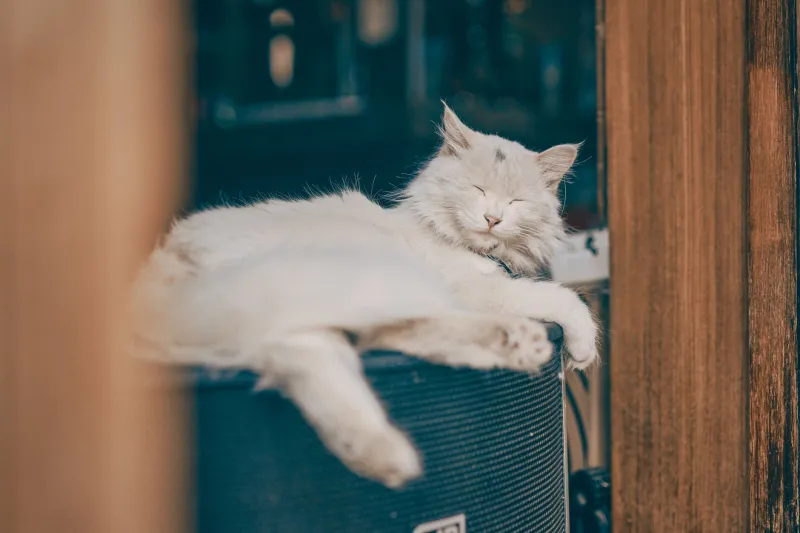
- Tail flicking, ears flattening, or leaving the room = time to change the playlist
- Excessive grooming or hiding = the music may be adding stress, not removing it
Start with lower volume than you think you need. Cats' sensitive hearing means that "background music" for you can be quite present for them. Give each genre a few sessions before drawing conclusions — novelty alone can trigger alertness that fades once something becomes familiar.
Building Your Genre Rotation
Once you have a read on what your cat gravitates toward, you can start matching genre to moment:
- Morning energy: Gentle jazz with a slightly brighter tempo
- Midday background: Slow classical or melodic ambient
- Afternoon play session: Slightly more rhythmic classical (think Vivaldi's quieter movements)
- Evening wind-down: Deep ambient or slow Satie-style piano
- Overnight: Pure ambient, nature sounds, or species-specific cat music
The goal isn't to fill every hour with sound — silence still has value, and cats benefit from quiet too. But when you do put something on, making it intentional means it actually works.
Your cat has opinions about what's playing. They're just expressing them in cat. Learning to read those signals is one of the more rewarding things you can do as a pet owner — and it starts with paying attention to what happens the moment you hit play.