Why Your Cat Hears Everything — But Only Cares About Some of It
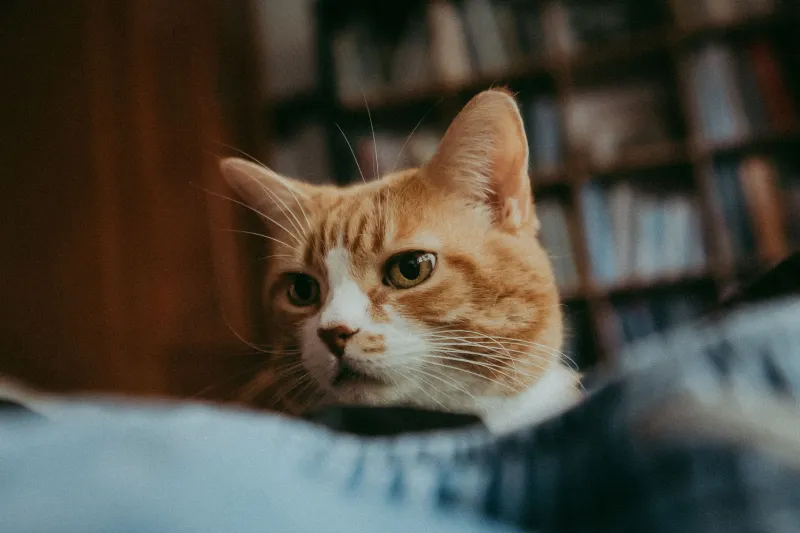
You've probably seen it happen a hundred times. Your cat is dead asleep on the couch while your roommate vacuums three feet away. Then you quietly tear open a treat bag from the other room, and suddenly — boom — wide eyes, perked ears, full attention. It seems almost unfair, honestly.
But this isn't your cat being dramatic or selectively difficult. There's real biology behind why certain sounds get filed under "ignore" while others trigger an immediate, full-body response. And once you understand the mechanics of feline auditory selectivity, you'll start thinking about your home's soundscape in a completely different way.
The Ears Have It: A Quick Anatomy Lesson
Cats have some of the most sophisticated hearing equipment in the mammal world. Their outer ears — those elegant, swiveling triangles on top of their heads — can rotate up to 180 degrees independently of each other. This isn't just cute. It's a precision targeting system that lets them localize sound sources with remarkable accuracy.
Beyond the mechanics, cats can hear frequencies ranging from about 48 Hz on the low end all the way up to 79,000 Hz on the high end. For comparison, humans top out around 20,000 Hz. Dogs, often held up as the gold standard of animal hearing, cap out somewhere around 65,000 Hz. Your cat is, in a very real sense, hearing a version of the world that you simply can't access.
But here's the thing — hearing a wide range of frequencies doesn't mean your cat is paying equal attention to all of them. The brain does a lot of filtering work, and that filtering is shaped by millions of years of evolution.
What Evolution Actually Built Cat Ears For
Cats are obligate carnivores and, in the wild, solitary hunters. Their survival depended almost entirely on their ability to detect small, fast-moving prey — mice, voles, birds, insects. These animals produce very specific kinds of sounds: high-pitched squeaks, rapid rustling, the ultrasonic vocalizations that rodents use to communicate.
This is why your cat's auditory system is essentially tuned to a specific frequency range, roughly between 500 Hz and 32,000 Hz, with peak sensitivity sitting somewhere in the 8,000 to 16,000 Hz zone. Sounds in that range get processed with extra urgency. Sounds outside of it — like low rumbling engines or the bass-heavy drone of most human speech — tend to register as background noise.
The vacuum cleaner that doesn't wake your cat? Mostly low-frequency mechanical rumble. The treat bag crinkling? High-frequency rustling that mimics the sound of prey moving through dry leaves. Your cat's brain isn't ignoring the vacuum — it's correctly classifying it as irrelevant to survival.
The Role of Familiarity and Predictability
Frequency is only part of the story. Cats are also incredibly attuned to novelty and pattern disruption. A sound your cat has heard a thousand times — the hum of the refrigerator, the ambient noise of a running dishwasher — gets categorized and stored as "safe and ignorable." The brain essentially stops sending alerts about it.
But a new sound, or a familiar sound appearing in an unexpected context, immediately gets flagged for attention. This is why your cat might sleep through your daily alarm but bolt upright when you drop a pen. Same general volume level, completely different response — because one is a known pattern and one is a deviation from it.
This also explains why sudden silence can sometimes unsettle cats just as much as sudden noise. If the ambient soundscape of a home changes dramatically — say, the white noise of an air conditioner shuts off in the middle of the night — that disruption to a familiar pattern can trigger alertness in a cat who was otherwise perfectly calm.
What This Means for Your Home's Soundscape
Here's where this gets genuinely useful for everyday cat owners. If you're trying to create a calming audio environment for your cat — whether they're home alone, dealing with anxiety, or just generally high-strung — understanding frequency selectivity gives you a real framework to work with.
Low to mid-range ambient sounds, like gentle nature recordings featuring rain, distant water, or soft wind, tend to fall outside the frequency range that triggers your cat's prey-detection instincts. They register as environmental backdrop rather than something to investigate. Music with slow tempos and minimal high-frequency percussion tends to have a similar effect — it fills the sonic space without poking at the parts of your cat's brain that are wired for alertness.
On the flip side, sounds with lots of high-frequency content — certain kinds of electronic music, sharp percussive elements, even some birdsong recordings — can actually have the opposite of a calming effect. They hit the exact frequency range your cat's auditory system is designed to take seriously.
There's also some interesting research suggesting that cats respond more positively to music composed specifically with their hearing range and natural vocalizations in mind — what researchers sometimes call "species-appropriate music." These compositions incorporate tempos and tonal patterns that mirror feline communication rather than human musical conventions, and the behavioral results in studies have been notably different from just playing classical music in the background.
Practical Ways to Tune Your Environment
You don't need a degree in animal acoustics to apply any of this. A few practical things worth trying:
Layer sounds thoughtfully. Instead of relying on a single audio source, consider building a soundscape with multiple gentle layers — soft ambient music underneath a subtle nature recording, for instance. This creates a richer, more consistent sonic environment that's harder for your cat to fixate on any single element of.
Introduce new sounds gradually. If you're adding something new to your home's audio environment, don't just blast it at full volume from day one. Let your cat's brain categorize it as familiar over time before you rely on it as a calming tool.
Pay attention to your cat's reaction, not just their inaction. A cat that's ignoring a sound isn't necessarily comfortable with it. Watch for subtle stress signals — flattened ears, a low tail, excessive grooming — even when your cat seems outwardly still.
Consider the time of day. Cats tend to be most alert around dawn and dusk, which aligns with their natural hunting windows. Ambient sound that works beautifully as a midday backdrop might need to be adjusted during those higher-alertness periods.
The Bottom Line
Your cat isn't ignoring sounds because they're aloof or indifferent. They're running an incredibly sophisticated filtering system that's been refined over thousands of generations of hunting and surviving. The sounds that get through that filter are the ones that matter to a small, efficient predator. Everything else gets filed away.
Once you start thinking of your home's audio environment through that lens, you're not just picking background music — you're making choices that either work with your cat's neurology or against it. And that's a pretty powerful thing to have in your back pocket as a cat owner.