Tuned In or Tuned Out: The Frequency Science Behind What Your Cat Actually Hears
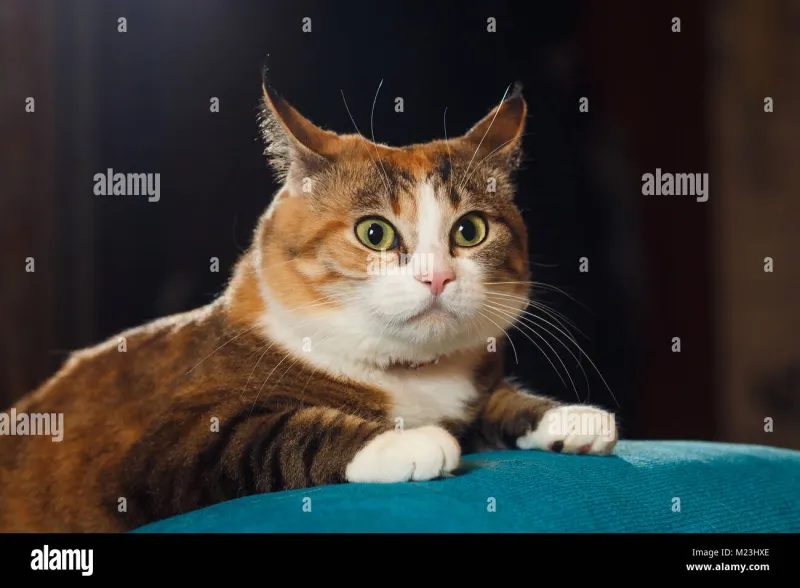
Photo: close-up cat ears listening alert expression, via c8.alamy.com
You've probably queued up a lo-fi playlist or turned on rain sounds thinking your cat would melt into a puddle of relaxation right alongside you. And maybe they did — or maybe they gave you that classic thousand-yard stare and walked out of the room. Here at Cat Calm Radio, we think a lot about why that happens. It turns out, the answer lives deep in the biology of your cat's ears, and it's way more interesting than you might expect.
Cats Hear a World You Literally Cannot
Human hearing tops out at around 20,000 Hz. That's our ceiling. Your cat's ceiling? Somewhere between 64,000 and 79,000 Hz — nearly four times higher than ours. That's not just a fun trivia fact; it's the foundation of everything when it comes to sound design for felines.
Cats evolved as precision hunters, and their auditory system reflects that. Those independently rotating ears aren't just cute — they're biological satellite dishes, capable of pinpointing the exact location of a mouse rustling under leaves from dozens of feet away. The frequencies that matter most to a hunting cat sit in a range that most relaxation music for humans doesn't even touch.
What this means practically is that a lot of the ambient music we love — deep bass tones, slow piano, low-frequency nature sounds — registers as somewhere between background noise and total silence to a cat. It's not that they don't notice it. It's that it doesn't speak their language.
The Sweet Spot: Mid-to-High Frequencies and Why They Work
Research out of institutions like the University of Wisconsin–Madison has shown that cats respond most readily to sounds in the frequency range of roughly 8,000 to 16,000 Hz — the acoustic neighborhood where kitten vocalizations and small prey sounds live. This is why music specifically composed for cats (yes, that's a real field) tends to feature sliding, glissando-style tones, tempos that mirror nursing rhythms, and higher-pitched melodic elements rather than the bass-heavy or mid-range sounds humans gravitate toward.
Composers like David Teie have pioneered what's sometimes called "species-specific music," and peer-reviewed studies have actually validated the approach. Cats exposed to music designed around feline-relevant frequencies showed measurably lower stress indicators — things like reduced hiding, more relaxed posture, and slower breathing — compared to cats exposed to classical music composed for human ears.
On Cat Calm Radio, this is exactly why the audio we curate leans into those higher harmonic layers. A track that sounds almost ethereal or chime-like to human ears is often hitting a cat in exactly the right neurological sweet spot.
Overtones, Harmonics, and the Feline Brain
Here's where it gets really interesting. It's not just about the fundamental frequency of a sound — it's about the overtone series that rides along with it. Every note you hear is actually a cluster of frequencies stacked together, and cats process those harmonic relationships differently than we do.
In humans, certain harmonic patterns trigger the parasympathetic nervous system — that's the "rest and digest" mode that makes you feel calm. For cats, the harmonic patterns that produce a similar response are higher up the scale and more closely mimic the tonal qualities of feline communication: chirps, trills, and the rhythmic pulsing of a purr.
Interestingly, the purr itself — which typically oscillates between 25 and 150 Hz — may function as a kind of internal reset button for cats. Some researchers believe cats purr not just to communicate but to self-soothe, using the vibration to regulate their own nervous systems. Ambient audio that incorporates purr-adjacent rhythmic patterns may tap into that same self-regulatory mechanism from the outside.
The Sounds That Backfire
Just as important as knowing what works is knowing what doesn't. Several common ambient sound choices that humans find deeply relaxing can actually stress cats out or simply fail to register as meaningful.
Heavy bass and low-frequency rumbles — think thunderstorm tracks with lots of sub-bass, or certain electronic ambient music — can land in a range that cats associate with threat signals. Deep, low vibrations in the wild often signal large animals or environmental danger. Even if a cat doesn't consciously react, chronic low-frequency exposure can elevate baseline stress.
Erratic or unpredictable sound patterns are another problem. Humans often enjoy ambient tracks with occasional dramatic shifts — a sudden swell, a rainstorm that intensifies. Cats, being creatures of routine and environmental control, can find those surprises alerting rather than soothing. Consistency and predictability in audio design matter a lot for feline nervous systems.
High-pitched but harsh sounds — certain synthesizer tones, distorted audio, or poorly compressed digital files — can land in the frequency range cats are most sensitive to but in a way that's abrasive rather than calming. Quality of sound matters as much as pitch.
What Good Cat Audio Actually Sounds Like
So what should you be listening for when you're choosing ambient sound for your cat? A few markers of genuinely cat-friendly audio:
- Smooth frequency transitions — gradual glides between tones rather than sharp jumps
- Consistent tempo — ideally somewhere in the range of a resting heartbeat or a nursing rhythm (around 50–80 BPM)
- Layered mid-to-high harmonics — think gentle chimes, soft strings played in higher registers, or carefully designed nature sounds featuring birdsong and light water
- Minimal sub-bass — or none at all
- Low dynamic range — meaning the volume stays relatively stable without jarring shifts
The goal is audio that feels like a warm, predictable environment to a cat's nervous system — not exciting, not stimulating, just safe and steady.
Your Cat's Ears Know Best
Ultimately, your individual cat is still your best data point. Some cats are more sound-sensitive than others, and breed, age, and past experiences all play a role in how a cat processes audio. But starting with the science — understanding that your cat is literally hearing a different version of the world than you are — is the foundation for making smarter choices about the sounds you share with them.
Next time you flip on a playlist for your cat, think less about what relaxes you and more about what their nervous system was designed to find comforting. The right frequencies aren't just background noise — they're a form of communication your cat's brain was built to receive.